
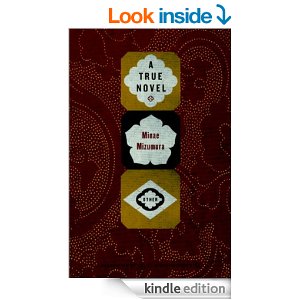
 How do I describe this novel? It haunts me in ways that I find hard to articulate and even understand. I picked this book up first, because it was about postwar Japan and secondly, it was about star crossed lovers-a “Wuthering Heights“ set in Japan, or so the reviewers said. “Intriguing,” I thought and bought the book. But from the very beginning it became clear that this was so much more than a Japanese Wuthering Heights.
The book begins with the author, a novelist, explaining that she was given a gift. Someone told her a “story just like a novel” about Taro Azuma, a person her family knew when they lived in New York in the early 60’s. The author explains, however, that trying to convert this true story into a novel in Japanese was difficult. What she was attempting was “close to rewriting a Western novel in Japanese,” but the novel would, of course, have to follow the inner logic of the Japanese language and culture and stay true to the time period of twentieth century Japan. All those difficulties could be overcome, however, writing a “true novel” where the author creates a world like “Wuthering Heights,” in which the author does not appear or narrate, causes Japanese readers to feel that the story is somehow less true. Instead, Japanese authors tend to use the “I-novel” form where the author is present in the story by either narrating or participating in some way as an “I,” thus creating a sense of realism and groundedness that a Japanese reader can identify with. “What was at stake,” our author notes, “wasn’t what is usually referred to as the problem of realism; rather, it was a problem with the “power of truth.” And so the author decides to employ this “I-novel” form and tells the story of Taro Azuma beginning with her family’s encounters with him.
Taro came to the United States looking for a way to overcome his impoverished orphan upbringing. He begins by becoming a chauffeur for a US businessmen but quickly moves to sales for the author’s father’s company and rises to the top. he then leaves that company, riding the wave of the Japanese economic miracle to become extremely wealthy and then disappears, seemingly without a trace. All this our author knew about Taro, but many years later when she was in Palo Alto teaching a class on writing she is approached by a young man named Yuuske, who heard the other side of the story. Disturbed by what he heard he decides he needs to share this with someone and chooses our author because of her distant connections to Taro. Through Yuuske, we hear the full story, of the rich family who took Taro under their wing and their daughter who befriended him, and the gulf of culture and money that drove Taro to the United States. We also meet the three sisters who lived next door to the family and observed the developing connection between the two children and Fumiko the sisters’ maid who became the confidant to the lovers.
If this story was only about these two lovers it would not be nearly interesting enough to sustain our interest through it’s 800 pages, but Mizumura fully develops and uses the different characters like Fumiko and the three sisters and their intertwined lives with Taro to full effect, giving a full perspective of life in Japan from the 50’s through to the 90’s. From their personal experiences we learn how the rising economy and the influence of the western world begins to change not only our characters but the culture and values of Japan as well.
What was most evocative for me is the time the characters spent during the summer in Karuizawa, a summer resort where I spent every summer growing up in Japan. The descriptions of the old town matches my own memory of those years and the evocative language describing the gentle rain, mist and fog that is ever present, the moss covered walls and gardens, and the old wooden “western style” homes made me homesick and wish I could go back again.
Mizumura is a gifted writer and is able to articulate the subtle and not so subtle cultural differences that exist between the US and Japan with a keen eye and a clear truthfulness that I admire. The translation by Carpenter is excellent and transparent so that you are able to sink into the rhythm of Mizumura’s prose without any awkward barriers. The pictures that appear every so often throughout the book make it feel less like a novel and more like a family history or album.
I think I will have to sit with this book for awhile. It haunts me and evokes a nostalgia for a time and place that no longer exists except in my memory and now here in this true novel.
Brenda’s Rating: *****(5 Stars out of 5)
Recommend this book to: Keith, Sharon, Ken, Marian and Lauren
Book Study Worthy: Yes!
Read in ebook format.
 Brenda's Bookshelf
compelling review, brenda. wh
LikeLike
Would like to read this book, “A True Novel”. Dad H.
LikeLike