
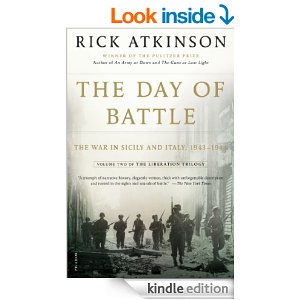
 The war in Italy was horrific. “The 608-day campaign to liberate Italy would cost 312, 000 Allied casualties, equivalent to 40 percent of Allied losses in the decisive campaign for northwest Europe at Normandy. Among the three quarters of a million American troops to serve in Italy, total battle casualties in Italy would reach 120,000, including 23,501 killed.” The mission of the Italian campaign was two-fold: To free Italy of Nazi German presence, including the removal of the fascist government of Mussolini, and to pin down and siphon off German military manpower and materiel from the main front of battle in northern Europe.
In order to do this the Allies moved the army that had been fighting in North Africa across the Mediterranean landing in Sicily with the intent of moving methodically up to their ultimate goal of Rome. By this time Eisenhower has become a bit more decisive, but Roosevelt and especially Churchill continue to exert a heavy influence on strategy and battle decisions. Indeed, the decision to even invade Italy was argued over and over again, with many in the US unsure of the wisdom of such a strategy and the British, especially Churchill, convinced that it was the only way they could siphon off and occupy German military power which would help in the northern European theatre. Eventually Roosevelt and Eisenhower agreed. Harold Alexander was designated as the British commander in Italy and Mark Clark was the US commander of the 5th Army and their intense personal hatred for each other and rivalry to become the first to enter and liberate Rome becomes an ongoing theme in this story.
But the glory of liberating Rome was long and arduous and places like Salerno, Naples, Anzio, Monte Cassino and San Pietro were to become the Allied training grounds for amphibious landings, learning to fight in rugged and inhospitable terrain and learning how to outsmart and outflank the enemy: all lessons that would prove important in the battles that lay ahead in northern Europe but which came at considerable cost.
This is the second book in Atkinson’s trilogy about WWII, following The Army at Dawn which I have previously reviewed. Atkinson again uses the private letters and journals of generals and soldiers to reveal the inner emotion and feelings of the people involved in each action of the war. We see how the the differences in culture within the Allied command from Indian Gurkhas to Polish freedom fighters in addition to the differences between the US and British contributed to an army that seemed disjointed and lacking the ability to communicate. Kesselring, the German Commander in Italy notes that over and over again the Allied army missed or was not able to take advantage of his vulnerabilities, an observation that Atkinson not only agrees with but attributes to Allied commanders who were not communicating well and who didn’t trust each other.
Atkinson writes eloquently and his observations are insightful. Although many historians, particularly British historians dispute the validity of the decision to invade Italy, Atkinson’s analysis is much more nuanced. There was an inevitability about the Italian campaign, he feels, since there was no capacity to ship the amies located in North Africa to the front in northern Europe and no where else for them to go. In addition the Allies were also concerned about the Russian’s displeasure if they saw an Allied army idling, while they were struggling. and so invading Italy inevitable. He also believes that had it not been for the experience gained on the ground in Italy, that initially the northern European campaign would have gone much worse. For Atkinson the Italian campaign was
…not just a military campaign but also a parable. There were lessons of camaraderie and duty and inscrutable fate. there were lessons of honor and courage, of compassion and sacrifice. And then there was the saddest lesson, to be learned again and again in the coming weeks as the fought across Sicily, and in the coming months as the fought their way back toward a world at peace: that war is corrupting, that it corrodes the soul and tarnishes the spirit, and even the excellent and superior can be defiled, and that no heart would remain unstained.
And that is a lesson we still cannot seem to learn.
Brenda’s Rating: ***** (5 Stars out of 5)
Recommend this book to: Keith and Ken
Book Study Worthy: Yes
Read in ebook format.
 Brenda's Bookshelf