
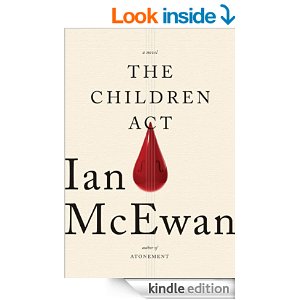
 Fiona Mayes is a British High Court Judge in London’s Family Division. There she hears cases dealing with families; mostly child custody but also some divorce. She is committed to her work and “…belonged to the law as some women had once been brides of Christ,” crafting her judgements with meticulous care and authority. She has been married to her husband Jack for thirty years. She thought her marriage was a warm and solid, until her husband told her recently that he wanted to see another woman. Instinctively she had told him that if he saw someone else he would have to leave their home, which he did. She was, she thought, “[a]n abandoned fifty-nine year old woman, in the infancy of old age, just learning to crawl.”
Luckily, in spite of the emotional upheaval in her personal life, her work is engaging and demanding and she immerses herself in it. In addition to her normal caseload an urgent case has landed on her docket. Adam Henry, a young boy, seventeen, almost eighteen, is refusing blood transfusions as part of his treatment for leukemia on religious grounds-he and his family are Jehovah’s Witnesses. Because of the severity of his condition, Fiona decides to visit Adam in the hospital after hearing arguments in court, so that she can evaluate for herself the sincerity of his beliefs and see first hand whether there is undue pressure from either his family or leaders in the church influencing him to decline treatment. At the hospital she finds that Adam is an impressive young man, interested in art and poetry, filled with life even as he is dying, and completely committed to his faith. And now Fiona must decide his fate according Section 1(A), The Children Act, 1989, which states that “When a court determines any question with respect to . . . the upbringing of a child . . . the child’s welfare shall be the court’s paramount consideration.”
Like he did in Saturday or Atonement, McEwan in spare, tranquil prose delineates the circumstances of his characters and follows them as they wrestle over the choices they face. Fiona has to face into the limits of her ability to save every child that comes into her courtroom even as she struggles to decide whether her own marriage is worth saving. With steely compassion, McEwan allows us to glimpse the raw emotions of grief, anger, denial and love that Fiona feels and through her helps us confront the moral and ethical dilemmas which are highlighted in her situation. Thoroughly engaging and thought provoking, this is a book that should not be missed!
Brenda’s Rating *****(5 Stars out of 5)
Recommend this book to? Keith, Sharon and Marian
Book Study Worthy? Yes!
Read in ebook format
 Brenda's Bookshelf