
I don’t know about you, but as a reader I often fall into a rut. I will find a certain author or genre that I like and will read them almost exclusively until I am bored or forced to read something else by someone you can’t refuse! (You know who you are!) Recently, however, I noticed that I was in another kind of rut, one that was geographic. I realized that I tend to read authors from North America, Western Europe (mostly Great Britain) or Japan and basically ignore the rest of the world. So this year I have been trying to include books outside my normal range in order to expand my horizons and gain new perspectives.
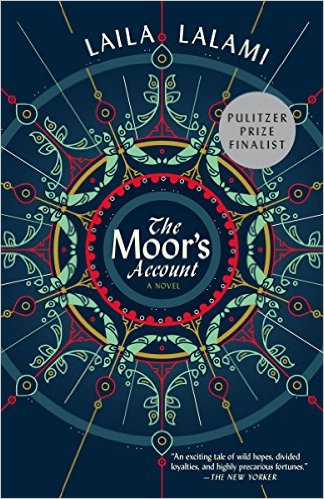 The Moor’s Account by Lalami, a Pulitzer Prize finalist, satisfies my criteria on several counts: Lalami was born and raised in Morocco and the book is about a Moroccan slave named Mustafa whose Spanish master, Dorantes, joins an expedition to claim a part of the New World for the Spanish crown.
Mustafa, known by his master and the others on the expeditions as Estabanico, begins his narrative as a counter point to the official story that is eventually told by the survivors of the expedition, and a grim and awful tale it is. Starting out in 1527 with a crew of six hundred men and nearly a hundred horses, the conquistador Pánfilo de Narváez sailed from the port of Sanlúcar de Barramedto towards the Gulf Coast and Florida. Their goal was to find a city of gold rumored to exist in this New World and to return with more wealth and become more famous than Hernán Cortés.
But from the beginning the expedition is plagued with problems. Navigational errors and poor judgement cause the expeditionary forces on land to become separated from their ships and supplies and soon they are decimated by disease and the persistent resistance of the local tribes.
As he narrates the expeditions failures and rapid decline, Estabanico’s unerring eye for truth and his unsentimental portrayal of his fellow expeditioners allows us to confront the greed and moral failure at the root of the expedition. Ironically, the expeditions’ precipitous decline eventually forces them to rely on the kindness and generosity of the local tribes who only a short while earlier they were trying to kill or subdue into slavery. But in spite of that, many of the survivors, rather than being grateful, resent this kindness and refuse to engage the natives as equals, and insist on clinging to their vanished and questionable superiority.
Lalami recreates the age of conquest vividly. Estabanico is a wonderfully insightful narrator and his “otherness;” of being a slave and a moor rather than European give us another perspective in looking at our history. Her characters are complicated and multi dimensional and her portrayal of the native peoples is nuanced and realistic without becoming romantic. When an author can not only transport you to another time and place but also to a different perspective and understanding, that is a gift! A gift I could not have received without stepping out of my own comfort zone.
Brenda’s Rating: ****(4 out of 5 Stars)
Recommend this to: Keith, Ken, Lauren, Marian and Sharon
Book Study Worthy: YES!
Read in ebook format.
 Brenda's Bookshelf