
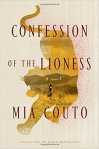
 The remote village of Kulumani, Mozambique is under attack. For weeks now something has been stalking the women of the village and killing them. They are the vicious bloody attacks of a wild animal, probably lions, who now have a thirst for human blood. The village elders unable to protect the village or the workers of a large company working on a project nearby have done the unthinkable and acquiesced to allowing the company to retain a hunter to kill the lions who are on a killing rampage.
Told between the alternating perspectives of Mariamar, a young girl in the village who has lost her older sister, Silencia, to the lions and Archangel Bullseye, the mulatto hunter who comes to kill the lions, the story weaves in the legends and beliefs of this remote village with the rules and skill of the hunter, giving an almost dreamlike quality to the narration.
Mariamar, who remembers the hunter from many years ago when he came to the village, hopes that this time he really will take her away from the village as he promised so long ago. She knows that there is something sickening the village, but unable to put her growing unease into words, she instead describes her mother’s flouting of the tribal customs and taboos while all the while her father must continually reassert the authority that so often escapes him. “[T]he order of the universe…governed by those laws that neither God teaches or Man explains,” seems to be crumbling and shifting all around her and Mariamar is witness to this disintegration without the ability to stem its tide or alter its course.
Archangel Bullseye, on the other hand, comes from a family of hunters. His father and his brother were also hunters, and yet Archangel is now alone, his father killed by his brother’s own hand. His brother now spends his days locked away in a mental hospital in the capital, leaving it to Archangel to continue the family’s hunter legacy. Archangel’s world is defined by what he can see, hear and touch and it is his knowledge and skill that makes it possible to track his prey and kill them. But even he can see that all is not what it seems in the village of Kulumani.
Based on an actual experience in working for a company who did seismic prospecting in northern Mozambique in 2008, Couto has created a story where the modern collides with age old customs and understandings. His characters are deftly portrayed and given their full voice. We can feel the intensity of the fear of the villagers and the hope that the old ways can be preserved even in the face of outsiders and the change they bring. We can sense the fear in those who are confronted with more than what they can see, hear or touch and their inability to understand or react to it. In the end it is a cautionary tale where distinctions between men and women, the powerful and the disempowered, and the inability to redress wrongs that have been committed against those who have no voice, haunt the pages and lurk in the shadows waiting for the moment when they can be set free. This is one of the most powerful and provactive books I have read in a long time!
Brenda’s Rating: *****(5 Stars out of 5)
Recommend this book to: Sharon, Marian, Lauren Keith and Ken
Book Study Worthy? YES!
Read in ebook format
 Brenda's Bookshelf