
In last week’s blog I talked about the trend in fake news aimed at the left. Much to my chagrin some of the sites that have been egregious in disseminating fake news are sites that I read regularly. Sigh! So this week I want to talk about some ways of spotting fake news and what to do to get more balanced and fact based news coverage.
The first thing is to know your news sources and how they skew on the bias scale. There are many ways to figure this out, but I found that this chart by Otero a good place to start. It’s not perfect but it helps you see what you are taking in and where that lands on the scale of bias on the horizontal axis and also rates the analytical quotient in the vertical axis. 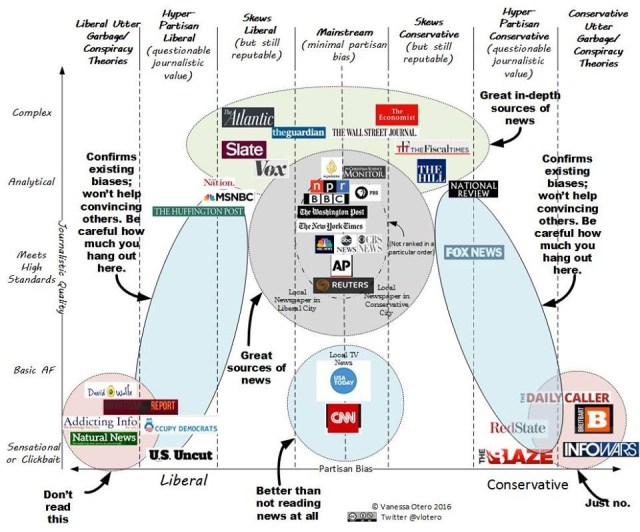 What news do you read and where does it land on the chart?
So I subscribe to the Post and the weekend New York Times and we get the Economist. I watch CNN at home and listen to NPR whenever I am in the car. So far my choices are minimally biased, although I could probably do better than CNN which tends toward “sensational” in its analysis. It is my Facebook feed though that is more problematic. I love the articles in The Atlantic which skews liberal although analytical, but since I also read The Economist maybe these two balance each other out. But Occupy Democrats, the Palmer Report and others which are not listed but which I am sure fall into the same category, like Mother Jones, are clearly only confirming my own bias rather than opening me up to new insights.
Snopes’ Managing Editor, Brooke Binkowski told BBC News in an interview that you need to be aware of your emotions as you read any news article. “If you are a newsreader or someone who likes reading news but you don’t know immediately what may or may not be fake, ask yourself by reading the headline, what emotions do I feel? Am I really angry, scared, frustrated, do I want to share this to tell everybody what’s going on? If the answer to any of these questions is yes, then check your sources.”
So how do you check to see if a news source is biased? Go to Media Bias/Fact Check. They seem to be amassing a alrge data base of various new sites and will let you know what their bias is. For example Mother Jones is considered a left leaning news site but their factual reporting is rated “high” and considered fairly reliable where as the Palmer Report ,which is rated almost to the extreme left, is rated “mixed” as far as reliability and accuracy. There are continuous updates to this site so that you can see when a news site has published something fake.
Once you have an idea of where your bias is then you can take some other steps. One of the biggest issues in fake news is how fast it spreads. The example I gave in last week’s blok about Senator Markey is a case in point. The fake news that a New York grand jury had begun to investigate Trump’s Russian connections had gone viral in just a very short amount of time. So I have decided that I will not share on FB any material from sites that are very biased and or have been proven to be unreliable. This means no sharing of the Palmer Report for me. I just feel like I need to be part of the solution with regard to fake news, and this is an easy way for me to do that.
Additionally, I want to where possible share from the original source, especially on big news items. So when The New York Times broke the story of Don Jr.s meeting with the Russian lawyer, there were many different sites that were sharing it too. But most of them cited the NYT as their source and usually linked their story to theirs. I noticed that many of the more liberal sites had much more sensational headlines and conclusions that were stretching things quite a bit. So now I am trying to be more careful and go to the original reporting and share it instead.
These are small steps, but I want to do my part in stopping fake news. I hope you have found this helpful in coming up with your own strategies to stop fake news.
 Brenda's Bookshelf