
Neal Stephenson intrigues me. When I read Cryptonomicon I was totally hooked by both the subject of cryptography and the thriller/suspense plot. But then the Baroque Cycle came out- a three part series about the history of science and philosophy. It was so dense, and full of science jargon with little or no plot lines to follow that although I started Quicksilver, the first book in the series, several times I could never get past page 100. But then other books followed, Anathem, and Reamde which I really enjoyed.
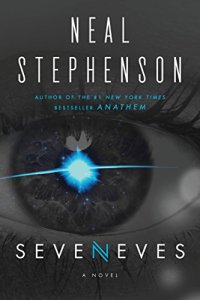 One thing you can say about Stephenson is that he is not afraid of big books. Most of the books he writes are 800 pages or more, and they are filled with big ideas about philosophy, currency, science and history. He likes to tackle the big “what ifs”that are at the heart of all human undertakings and SEVENEVES is no exception.
Set in the near future, SEVENEVES starts off with a catastrophic event, where the moon is struck by some unknown agent and instead of exploding in a ball of fire it separates into seven huge boulders with a bunch of smaller rocks surrounding them. It takes several days before scientist began to realize that the repercussions of this event are truly alarming and detrimental to human survival. What hey realized was that the boulders are going to start crashing into each other, causing more and more pieces to orbit the earth which would eventually lead to many of those pieces losing orbit and falling to the earth in a meteorite bombardment that scientists began calling the Hard Rain. The real kicker, was that scientists estimated that the Hard Rain would last between five thousand and ten thousand years and cause the complete and total devastation of the surface of the earth.
With less than twenty five months to plan, humanity places their hopes on the ISS or International Space Station, to be the repository for life while the earth undergoes the devastation of the Hard Rain. They must expand the capacity for life on the ISS, and undertake the massive challenge of preserving the genetic material of all life on Earth so that if humanity survives it can re-propagate it with plants and animals as well as people.
Stephenson examines our most fundamental assumptions about life, the earth and our ability to survive. Thought provoking, with a breathtaking vision of possibilities, Stephenson allows us to dream of a dramatic and very different future for the world.
Brenda’s Rating: ****(4 Out of 5 Stars)
Recommend this book to: Keith, Ken and Marian
Book Study Worthy? Yes
Read in ebook format.
 Brenda's Bookshelf