
I have been sick since Christmas Day with a terrible hacking cold and cough. Yesterday, after being sick and tired of being sick and tired, I declared myself well and tried to get back to my normal schedule. Today I am feeling the effects of doing too much too fast. Sigh!
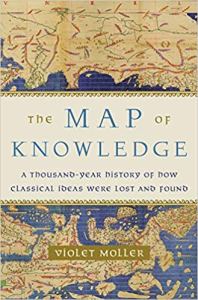 One of the compensations of being sick, however, is the ability to read without any guilt! One of the books that captured my imagination and kept me from feeling sorry for myself was The Map of Knowledge by Violet Moller. This is an intriguing book that traces how scientific knowledge discovered by the Greeks in Math, Astronomy and Medicine survived the fall of the Roman Empire, the burning of the great library in Alexandria. well as the plagues, war and the social upheaval that marked the Dark Ages and reemerge almost 1000 years later to fuel the Renaissance.
Moller traces three great Greek texts: Euclid’s Elements, Ptolemy’s The Almagest, and Galen’s writings on medicine as they made there way through these dark times -following the various translations as they appeared over time which allowed this knowledge to be disseminated more widely. As she follows these three texts, Moller discovers that seven cities emerged as repositories of knowledge and were instrumental in keeping the light of scientific discovery alive. These cities were Alexandria and its vast libraries where the Ptolemaic leaders encouraged the pursuit knowledge until the city was sacked and the vast library burned. Next is Baghdad, where remnants of the Greek texts were sought, studied and even improved on, while translating them into Arabic saved them from extinction. Cordoba and Toledo of Spain were unusual in that they encouraged trade with Muslim countries and knowledge of Arabic allowed the Arabic versions of the Greek texts to be translated into Latin. Meanwhile Salerno became a center for medical knowledge because its location on the coast of Italy encouraged the free flow of knowledge. Sicily, was that rare place in Western Europe which had retained contact with Greece and its language and culture and thus became the first place to go to when rare Greek texts were discovered and there they were translated into Latin or even local languages. Finally, Venice saw the potential of the printing press in the 1500s and translations of these important texts which had managed to survive since 500 AD were printed in large numbers and sent all around Western Europe fueling the Renaissance.
Moller’s clear writing style, and obvious excitement for her subject help keep this book informative and entertaining while at the same time imparting many important facts and historical context. One thing that came through loud and clear is that without the free flow of ideas and without the encouragement from leadership and government to pursue scientific research and knowledge our world would be a very, very different place today. A lesson that we seem to need to relearn once again!
Brenda’s Rating: ***** (5 Out of 5 Stars)
Recommend this book to: Everyone!
Book Study Worthy? Yes!
Read in ebook format
 Brenda's Bookshelf