
I’m not sure I would have ever picked this book up on my own but a friend told me that it was as important to her as the Bible and had changed her life. With a recommendation like that it was hard not to be intrigued! Luckily this same friend was leading a book study so I was able to read it with a group of people which made the reading experience even more enriching!
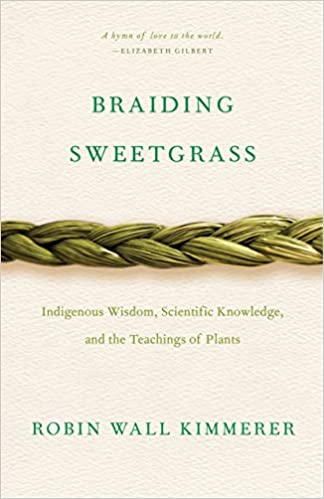
Kimmerer is a botanist, a Professor of Environmental Biology at SUNY, and a Citizen of the Potawatami Nation and integrates all of these diverse understandings of the world of plants, the environment and the wisdom of indigenous peoples into a cohesive whole that is much more than its parts. It is an ode to the abundance and resilience of plants, a warning to humanity that we must not abuse Mother Earth, but to interact with her with wonder and gratitude and a call to look to our past and the wisdom of the indigenous peoples to guide us to a new understanding and relationship with the natural world.
Kimmerer begins with this understanding:
In the Western tradition there is a recognized hierarchy of beings, with, of course, the human being on top– the pinnacle of evolution , the darling of Creation–and the plants on the bottom. But in Native ways of knowing, human people are often referred to as “the younger brothers of Creation.” We say that humans have the least experience with how to live and thus the most to learn–we must look to our teachers among the other speeches for guidance. Their wisdom is apparent in the way they live. They teach by example. They’ve been on the earth for far longer than we have been, and have had time to figure things out.”
From there Kimmerer leads us on a journey to understand the genius of of Native planting of the the Three Sisters–Corn, beans and squash together in one mound, the importance of an allegiance to gratitude, the Rules of the Honorable Harvest which helps maintain both habitat and ecosystem. She encourages us to look closely at how the plants regenerate themselves when the land has been misused and contaminated and learn from them how Mother Earth heals herself.
Kimmerer’s writing is lyrical and poignant. She tells stories of her family, of the students she has taught, of the wise counsel she has received from Native elders and the unexpected insights she has learned in her research and in her own backyard. As someone said, this book is “a hymn of love to the world” and Kimmerer extends an invitation for all of us to join in with three part harmony!
Brenda’s Rating:*****(5 Out of 5 Stars)
Recommend this book to: Marian, Lauren and Sharon
Book Study Worthy? YES
Read in paperback format.
 Brenda's Bookshelf
Dear Brenda, thank you for sharing Braiding Sweetgrass in your blog. It is a wonderful book, even if it is read for just a sheer pleasure of Kimmerer’s gift of language.
LikeLike
A friend also recommended this book. I’ll add it to my list. Thank you.
LikeLike