
As a translator I am fascinated by how words, phrases and texts morph from one language to another. For example there is a famous haiku poem by the Japanese poet Basho about a pond, a frog, and the noise of its jumping that has been translated many times into English. Here are three examples:
Into the old pond
A frog suddenly plunges,
The sound of water.
By Daniel C. Buchanan
old pond
a frog leaping-in
water note
by Cana Maeda
Old pond, yes, and,
Frog jumping into
the water’s noise.
by G.S. Frazier
 All of these poems and many others are collected in a wonderful book called One Hundred Frogs by Hiroaki Sato, which is a handbook on the art of translating Haiku and Renga styles of poetry. The differences in the tone, the choice of words, the way different things are emphasized in each translation are fascinating to me. Do you emphasize the act of jumping or the noise of the water? Which word do you use: jumping, leaping, plunges or something else? Is the pond old or ancient? Such are the dilemmas translators are faced with!
David Bello explains the idea of translation and its meaning in his book Is That a Fish in your Ear? Translation and the Meaning of Everything. His title is a humorous riff on Douglas Adams’ Hitchhikers Guide to the Galaxy in which a babel fish inserted into your ear would allow you to understand everything that was being said. Although Bellos, a professor of French and comparative literature at Princeton and who teaches courses on translation, maintains a lighthearted tone through out the book, his discussion about translation is actually quite serious. After all, wars have been started on no less than the the placement of a comma, or the mistranslation of the word “adjunct!”
Bellos explores the idea of meaning in translation and how words are always part of a 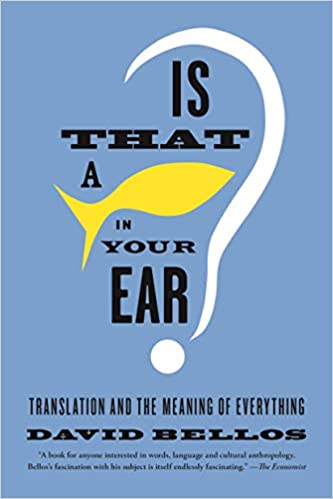 context. If you order a coffee in the morning at your local coffee store the words you use to order, “a tall latte,” have a certain meaning, but those exact same words may have a completely different connotation when used in another context. Common understandings between cultures is also necessary for some translations. For example if you ask someone in China, “Do you promise, cross your heart and hope to die,” in order to extract a promise of them, it would be important that they understand this common childhood understanding of making a promise, otherwise they might think that they will be cursed! In another chapter Bellos also explores the conundrum of translating words from one language into a language where such things do not exist. How do you translate the biblical phrase “white as snow” when snow does not exist in that language?
I found Bellos discussion of the ways in which the ways translations flow in a hierarchically very troubling. Since English is currently the dominant language in the world, translations into English are very important to authors from other countries, as their works can then be read by a wider audience. In fact recently many foreign authors are now writing in English directly rather than go to the trouble of having their works translated. However, what do we lose when one language becomes so widespread and other languages less accepted? If a Haitian author writes in English do we as an international community lose something?
Bellos and Sato have both stimulated my thinking and I often return to these books as I think about the impact words have on ideas, culture and society. We have recently seen #BlackLivesMatter and #MeToo cross international boundaries in protests all over the world, There is a universality to the human experience and yet there is also diversity in understanding, and the context in which these ideas take root and grow.
Brenda’s Rating: ***** (5 Out of 5 Stars)
Recommend these books to: Keith, Sharon and Ken
Book Study worthy? YES!
 Brenda's Bookshelf