
One of the things I have learned is that history told by the powerful, the winners and the the dominant is not a complete history. Unless we hear from the losers, the subjugated, or the powerless, we do not get the full picture of what happened.
There have been a number of books that I have reviewed that tell this kind of history: The Moor’s Account by Lalami about the exploration of the Central and South America, The Investigation by Lee about the incarceration and medical experimentation on Korean and US POWs by the Japanese during WWII, The Sympathizer by Nguyen, a Vietnamese perspective on the Vietnam War, and The Glass Palace by Ghosh about the British invasion of Burma in 1855. Most of these books are about foreign places, but in Beheld, Nesbit takes us to the roots of our own history; the fledgling colony of Plymouth.
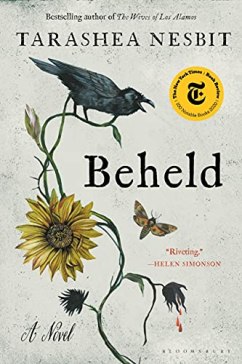 It has been ten years since the pilgrims arrived on the Mayflower and formed the colony of Plymouth. Although the colony was supposedly founded on the idea of religious freedom, Puritans have imposed strict rules that restrict the settlers from trading with whom they choose, living the way they choose and worshipping the way they choose. Out numbered, the Anglicans in the colony have been marginalized by the more zealous Puritans, so it is with some anticipation and hope that they welcome a new ship bringing more colonists and new directives concerning the management of the colony. Instead the ship and the new colonists bring even more tension and when a murder occurs, the trial reveals the true depths of the moral decrepitude in this seemingly God fearing colony.
The story is told from the perspective of two women-one a woman of some social standing with a pliant deferring personality and the other the wife of the town troublemaker and drunk, who has had to find an inner strength and hardness in order to survive. These two women offer us insights into the lives of women in the colony, the precariousness of life, the trials of motherhood and their powerlessness. As the story unfolds Nesbit explores the ways in which people justify acts that are morally reprehensible or promote injustice. In the process the book raises some important questions: Whose stories get told and become “History;” and what stories are discarded, dismissed or forgotten, and does it matter?
Brenda’s Rating: *****(5 Out of 5 Stars)
Recommend this book to: Marian, Sharon, Ken and Keith
Books study worthy? Yes!
Read in ebook format.
 Brenda's Bookshelf