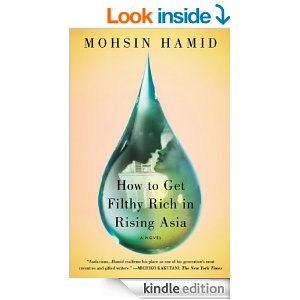
How To Get Filthy Rich in Rising Asia by Mohsin Hamid

How to get Filthy Rich_“Look, unless you’re writing one, a self-help book is an oxymoron. You read a self-help book so someone who isn’t yourself can help you, that someone being the author…None of the foregoing means that self-help books are useless. On the contrary they can be useful indeed, but it does mean that the idea of self in the land of self-help is a slippery one.”

And with this intriguing beginning we are thrown in to the beguiling story of one man’s journey to become filthy rich in rising Asia.

Our unnamed hero is the third child in a impoverished family who moves to a larger unnamed city somewhere in what might be India. And slowly, by following the precepts that begin with each chapter: “Move to the City,” “Get an Education,” and  “Don’t Fall in Love,” etc., he grows up and establishes himself as a successful businessman in the big city. What is interesting however is that although he does try to follow each precept, life is not always so cut and dried. The boy does try and get an education, but his opportunities for education are limited and corporal punishment the norm. The boy does fall in love with a “pretty little girl,” but for many reasons they are unable to be together, and although as a man becomes prosperous, prosperity does not bring him the satisfaction that it promised.

Narrated in second person with a wry and slightly condescending tone, this novel as self-help book is both unique and smart. The choice to leave both our narrator and the place unnamed lends a sense of universality to this book, but Hamid grounds it with details about our heroes’ family, the measures he employs to build up his business and the poignancy of the love story between our hero and the pretty little girl.

The writing is simple and directive, as one would expect from a self-help book and yet Hamid is able to bring a depth of understanding to this story that helps to bridge the gap between our experience and the experiences of those living in rising Asia with deft and sharpness:

“…Huddled shivering on the packed earth under your mother’s cot one cold, dewy morning. Your anguish is the anguish of a boy whose chocolate has been thrown away, whose remote controls are out of batteries, whose scooter is busted, whose new sneakers have been stolen. This is all the more remarkable since you’ve never in your life seen any of these things.”

This is a book that is informative, fun, and touching all at the same time-a true gem!

Brenda’s Rating: *****(5 Stars out of 5)

Recommend this book to: Keith, Ken, Sharon, Marian and Lauren

Book Study Worthy: Yes

Read in ebook format
Posted in Fiction, Literary Fiction | Tagged , , , , | Leave a comment

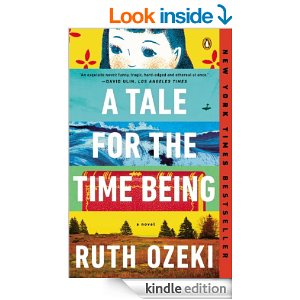
A Tale for the Time Being by Ruth Ozeki

A Tale for a Time Being_On a remote island in Canada, Ruth, a novelist who has been struggling with ennui and writer’s block, comes across a small package in the surf on the beach near her home. When she unwraps the package she finds a Hello Kitty lunchbox containing a diary written by a 16 year old girl in Japan, some letters written in Japanese, and some other mementos. Wondering if this package could be detritus from the Japanese Tsunami, Ruth, who herself is Japanese takes these gifts from the sea as a sign, and begins to read the diary, hoping that they might help her come to terms with her own life.

Nao, the young writer of the diary, announces in the first pages of her diary that she plans on killing herself, but has set herself the task of writing a biography of her great grandmother, a famous Buddhist nun, before she can carry out her plan. Initially, Nao wrties about what has brought her to this decision, but as she begins to chronicle the events of her great grandmother’s life both before and after becoming a nun, she begins to find out more about her own family; the uncle who was a kamikaze pilot in WWII and her own father who after failing in a job in the US during the dot.com bubble, returns to Japan as a shadow of himself.

Ruth, is soon caught up in the diary and as she realizes Nao’s strong commitment to kill herself, she wants to reach out and somehow stop what surely has already happened.  Ruth’s begins to do some research using clues she finds in the diary, but this leads her nowhere, and she is trapped both by time and lack of information and is unable to influence or change what is unfolding before her in the diary in the present but has already occurred in the past..

Ozeki is a gifted writer. She captures the cadence and attitude of both the 16 year old Nao and the gentle, obfuscating speech of  her 100 year old grandmother as well as depicting Ruth, a middle aged novelist who has seemingly lost her voice.  Ozeki writes with deep insight and a thorough knowledge of Japan and its culture, especially with regard to Nao’s re-integration into Japanese society after living in the US.  The subject matter of this book is quite challenging however, with themes of suicide, depression, extreme bullying, and the kamikaze pilots of WWII.  Although, Ozeki handles these themes with dexterity and grace, I sometimes felt overwhelmed by a cumulative sadness for these characters and their tremendous struggles and at other times I was furious at the defeatist attitude of Nao’s parents, particularly, her father. In the end however, Ozeki manages to bring this story to a satisfying, although somewhat contrived conclusion, and we are reminded again of our shared humanity, and the way we influence people without even knowing it

Brenda’s Rating: ****(4 Stars out of 5) 

Recommend this book to: Sharon. Lauren, Marian, Keith and Ken

Book Study Worthy? Yes

Read in ebook format.


Posted in Fiction, Literary Fiction | Tagged , , , , | Leave a comment

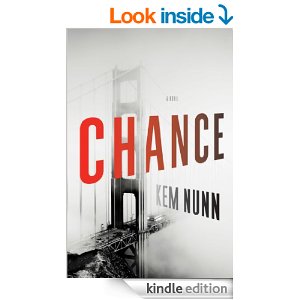
Chance by Kem Nunn

Chance_Dr. Eldon Chance is a forensic neuropsychiatrist working in LA, whose life, like many of his client’s lives, is slowly unraveling.  First there is his divorce and the money that will cost, then his daughter’s troubles at school and finally his unhealthy attraction to a client, Jaclyn Black, who is being abused by her LA cop husband.

Chance knows that his life is unraveling, after all he is a professional who sees people in this predicament all the time, but in the moment, as it happens to him, each step seems perfectly reasonable. Take for example his furniture. The pieces are antique and highly collectible pieces except for the damaged and lost details on a couple of the pieces, but the antique store owner he consults says not to worry they can be “restored” by his restorer, Big D, who will work his magic and then they can be sold to a collector as a complete set for a lot of money.  Chance knows this is a bit underhanded but he needs the money and so he decides to do it anyway.  And that his how he gets to know Big D, a former Iraqi war vet who is familiar with the underbelly of life, knowledge that Chance finds himself increasingly relying on as he deals with a corrupt revengeful cop, the Romanian mob, a kidnapping and a client with multiple personalities.  “Like Houdini,” Chance realizes, “we construct the machinery of our entrapment from which we must finally escape or die,” and Chance is hoping that he can escape.

Nunn is a good writer and has been compared to Raymond Chandler who  also wrote about things below the surface.  Nunn’s prose is lush and descriptive and he juxtaposes this with Chance’s voice which seems clinical and detached even as his world falls apart around him.  Somehow Nunn is able to walk the razor’s edge; allowing us to see how these choices seem completely rational to Chance and at the same time how truly irrational they are.  Big D is the key to this razor’s edge and is an amazingly complex character who I hope we see again. This is my first book by Nunn, but it will not be my last!

Brenda’s Rating: **** (4 Stars out of 5)

Recommend this book to: Sharon, Marian and Lauren

Book Study Worthy: Yes

Read in ebook format
 

Posted in Fiction, Mystery, Psychological Mystery, Thriller | Tagged , , | Leave a comment

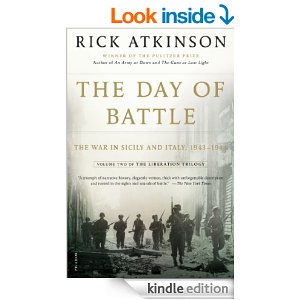
The Day of Battle: The War in Sicily and Italy, 1943-44 by Rich Atkinson

The Day of Battle_The war in Italy was horrific. “The 608-day campaign to liberate Italy would cost 312, 000 Allied casualties, equivalent to 40 percent of Allied losses in the decisive campaign for northwest Europe at Normandy.  Among the three quarters of a million American troops to serve in Italy, total battle casualties in Italy would reach 120,000, including 23,501 killed.”  The mission of the Italian campaign was two-fold: To free Italy of Nazi German presence, including the removal of the fascist government of Mussolini, and to pin down and siphon off German military manpower and materiel from the main front of battle in northern Europe.

In order to do this the Allies moved the army that had been fighting in North Africa across the Mediterranean landing in Sicily with the intent of moving methodically up to their ultimate goal of Rome. By this time Eisenhower has become a bit more decisive, but Roosevelt and especially Churchill continue to exert a heavy influence on strategy and battle decisions. Indeed, the decision to even invade Italy was argued over and over again, with many in the US unsure of the wisdom of such a strategy and the British, especially Churchill, convinced that it was the only way they could siphon off and occupy German military power which would help in the northern European theatre. Eventually Roosevelt and Eisenhower agreed. Harold Alexander was designated as the British commander in Italy and Mark Clark was the US commander of the 5th Army and their intense personal hatred for each other and rivalry to become the first to enter and liberate Rome becomes an ongoing theme in this story.

But the glory of liberating Rome was long and arduous and places like Salerno, Naples, Anzio, Monte Cassino and San Pietro were to become the Allied training grounds for amphibious landings, learning to fight in rugged and inhospitable terrain and learning how to outsmart and outflank the enemy: all lessons that would prove important in the battles that lay ahead in northern Europe but which came at considerable cost.

This is the second book in Atkinson’s trilogy about WWII, following The Army at Dawn which I have previously reviewed. Atkinson again uses the private letters and journals of generals and soldiers to reveal the inner emotion and feelings of the people involved in each action of the war. We see how the the differences in culture within the Allied command from Indian Gurkhas to Polish freedom fighters in addition to the differences between the US and British contributed to an army that seemed disjointed and lacking the ability to communicate.  Kesselring, the German Commander in Italy notes that over and over again the Allied army missed or was not able to take advantage of his vulnerabilities, an observation that Atkinson not only agrees with but attributes to Allied commanders who were not communicating well and who didn’t trust each other.

Atkinson writes eloquently and his observations are insightful. Although many historians, particularly British historians dispute the validity of  the decision to invade Italy, Atkinson’s analysis is much more nuanced. There was an inevitability about the Italian campaign, he feels, since there was no capacity to ship the amies located in North Africa to the front in northern Europe and no where else for them to go. In addition the Allies were also concerned about the Russian’s displeasure if they saw an Allied army idling, while they were struggling. and so invading Italy inevitable.  He also believes that had it not been for the experience gained on the ground in Italy, that initially the northern European campaign would have gone much worse. For Atkinson the Italian campaign was

 …not just a military campaign but also a parable. There were lessons of camaraderie and duty and inscrutable fate. there were lessons of honor and courage, of compassion and sacrifice. And then there was the saddest lesson, to be learned again and again in the coming weeks as the fought across Sicily, and in the coming months as the fought their way back toward a world at peace: that war is corrupting, that it corrodes the soul and tarnishes the spirit, and even the excellent and superior can be defiled, and that no heart would remain unstained.

And that is a lesson we still cannot seem to learn.

Brenda’s Rating: ***** (5 Stars out of 5) 

Recommend this book to: Keith and Ken

Book Study Worthy: Yes

Read in ebook format.

Posted in History, Non Fiction, Series | Tagged , | Leave a comment

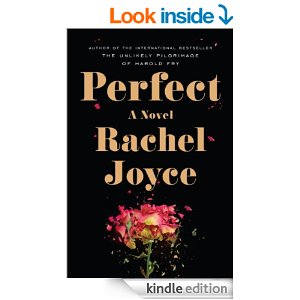
Perfect by Rachel Joyce

Perfect_Bryan Hemmings knew that time was going to slip at some point. It had been in the news that they were going to adjust it by a few seconds, a perfectly logical thing to do, or so Bryan’s friend James said, in order to match it to the earth’s rotation. But eleven year old Bryan is not so sure that they should be messing around with time and carries a sense of foreboding that something terrible will happen when they change time. And it did.

As they were driving to school one very foggy morning in the fancy new car that Bryan’s father had bought for his mother, something happened in just a split second that changed the course of Bryan’s life. Something that his mother who was driving and even his sister who was in the car didn’t even notice, but Bryan did and now he is sure that their perfect life will never be the same.

Over the next few days Bryan realizes that he cannot rely on his mother who seems oblivious to what happened and his father, who only comes from working in London on the weekends, cannot be relied upon either and so he confides in his best friend James and they devise a plan to save his mother and his family. But the more they try to help the more things seem to get complicated and then they slowly unravel until nothing is left of his former life.

Joyce has an uncanny ability to get in the mind of a child and lets us see how they see and understand their world . She sets things in motion and you can see them coming towards you like a train wreck that you cannot stop, and you understand the helpless feelings that Bryan experiences in his inability to help or change the course of events. She is able to unravel the barriers that prevent us from understanding mental illness and lets us see inside the mind of someone who in their effort to have control over things loses touch with reality and slips into magical thinking.  Her characters are sharply drawn and interesting and we see the consequences of secrets, pride and the lack of trust can have on a family.  Joyce, however finds unexpected redemption in the small things, and although Bryan’s life is no longer what he expected, he is drawn towards something new with the help of strangers he can claim his own new life.

Brenda’s Rating: ****(4 Stars out of 5)

Recommend this book to: Sharon, Marian, Lauren and Keith

Books Study worthy? Yes

Read in ebook format.


Posted in Fiction, Mystery | Tagged , , , | Leave a comment

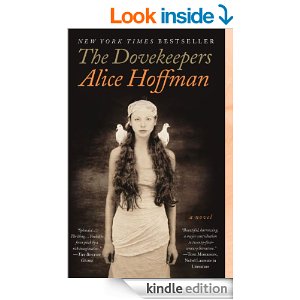
The Dovekeepers by Alice Hoffman

In 72 CE, 900 Jews sought refuge on the top of an ancient Herodian fort called Masada to escape from Roman persecution and the desecration of their temple in Jerusalem.  In the ensuing months these refugees would hold out against an entire Roman army who lays siege and seeks to destroy them.  In the end, Josephus, the Roman historian, reports that only two women and five children survived the siege at Masada.

The Dovekeepers_Based on these bare historical facts, The Dovekeepers, a novel, is the story of four different women who came to Masada in different ways, carrying different burdens, and seeking a place of refuge but finding instead a place of war and destruction: Yael, whose mother who died in childbirth, and rejected by her father, an assassin for the zealots; Revka, the baker’s wife, saw her daughter raped and killed by Roman soldiers and now cares for her mute and traumatized grandchildren; Aziza, raised as a boy in a Bedouin tribe, chafes at the limitations she faces because of her gender, and Shirah, her mother, born in Alexandria, gifted in the art of medicinal herbs and midwifery and has the ability to see others’ secrets even as she tries to hide her own.

Hoffman lets each woman tell her own story and as each voice adds their own perspective and insights we begin to see the whole of life for the refugees at Masada. As the women work in the dove cote, taking care of the doves and gathering the manure to feed the soil for the olive and fig groves, we see the connections they make with each other and with the men they encounter and their growing  understanding that the Masada they came to for refuge will now be their final resting place.

Hoffman has obviously done extensive research for this novel and she creates characters who are interesting, engaging, and whose stories we want to listen to. She also does not fall into the trap of creating women who are too modern in their sensibilities for their time and place, but rather has her characters wrestle with their role and place in society in ways that seem historically appropriate and natural.  I would have liked to have had more sense of the geography of Masada but overall Hoffman’s descriptions were interesting and helpful and her ability to bring to life one of the most poignant and terrible moments in history is outstanding.

Brenda’s Rating: ****(4 out of 5 Stars)

Recommend this book to: Sharon, Marian and Lauren

Books Study Worthy: Yes!

Read in ebook format.


Posted in Fiction, Historical Fiction | Tagged , , | Leave a comment

The Most Dangerous Thing by Laura Lippman

I am really enjoying Laura Lippman’s books! “What the Dead Know” was one of the first I read and I was immediately impressed with her insightful writing, her well developed characters and the role that Baltimore plays in each of her books.

Dangerous Thing_The Most Dangerous Thing is another great book, a stand alone story about some kids, the woods in Leakin Park and the consequences of what happened one summer.

The story opens with a terrible car crash and the uncertainty of whether or not Gordon, who was driving drunk meant to kill himself or whether it was just sheer stupidity that made him race down the road and hit the Jersey wall.  As his friends and family come together to mourn his loss, they discover that they are still reaping the consequences of what happened in the the summer of 1978.

Gwen and Mickey became good friends, although Gwen’s mother wasn’t too keen on their friendship, and during that summer of 1978 they are hanging out and exploring the woods behind Gwen’s home, which Mikey loves.  And then they met the “wild” Halloran brothers: Tim, Sean and Gordon or Go-Go as they called him. It was during that summer that they really got to know each other and it was also that summer that broke them apart.  For as Gwen says, “Our parents allowed us to roam the thickly wooded hillside of Leakin Park while warning us if its dangers… They tried, they really tried to anticipate everything that could bring us harm. But it was us in our naivete’ and heedlessness, who were to be feared. We were the most dangerous thing in the woods.”

Lippman’s finely crafted book is a delight to read. She captures the innocence of childhood and those lazy days of summer where there is nothing to do, but each days seems filled with adventure. She fully develops all her characters, but Gwen and Sean seem to particularly shine, especially in the grown up versions of themselves. Lippman is particularly gifted at grounding her story in the reality of Baltimore and in a time and place that she has lived, which adds another level of realism to her story. If you have not read Lippman yet, then you are in for a wonderful and this book is a great place to start!

Brenda’s Rating: ****(4 out of 5 Stars)

Recommend this book to: Sharon, Marian and Keith

Book Study Worthy: Yes

Read in ebook format.


Posted in Fiction, Mystery, Psychological Mystery | Tagged , , | Leave a comment

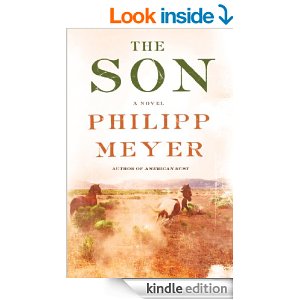
The Son by Phillip Meyer

The Son_This is a sweeping saga of the rise and ebbing fortunes of a Texas family who through sheer grit and ruthless tenacity create an empire but seem to lose their souls in the process.

In 1849 Eli McCullough is captured along with his brother in a brutal Comanche raid and is forced to watch his mother and sister raped and killed.  But he is determined to survive and lives at first as a slave but quickly learns to assimilate within the Comanche society and by the age of 16 has become a fierce warrior. But the Comanche are slowly dying as their lands are taken away and they are exposed to diseases from white settlers. Eventually, Eli must return to white society and ends up as a Colonel in the Rangers and settles in Texas with his wife and  family determined to create a dynasty.

The story is narrated by three different members of the family: Eli who is now 100 and is known simply as “the Colonel”; Eli’s son Peter, who calls himself the “the great disappointment” because he can’t seem to meet the expectation’s of the family’s vision of itself; and Eli’s great-granddaughter Jeanne Anne, who struggles to maintain the McCullough empire in the face of modern economic challenges.

As each narrator faces moral and economic challenges to their family’s wealth and position, the choices they make become more morally ambiguous and they in turn have to become more ruthless. At each juncture when they must make these decisions, it is clear that they each must also come up with a way to deal with the consequences of these ruthless choices and the toll on each one is the same: alienation and loneliness.

Meyer has written a big book (863 p.) with larger than life characters, especially the Colonel who dominates the family even long after his death. Each character is developed with care and we see them grow and change through the vagaries of economic change, the loves they choose and their ongoing interactions with this land that is their home. And yet there seems to be something missing in each one-a brokenness that seems to never be healed. Meyer seems strangely detached from his characters as he chronicles their lives and we never seem to sense any mercy or grace in his enumeration of who they were or what they did.

Meyer is eloquent in talking about the loss of the Comanche’s lifestyle and the destruction of the the Texas ecosystem by the introduction of cattle or even the shifting economic tides of oil production. There is much to mourn in this saga and very little to be proud of; a message that not many Texans let alone Americans will be happy to hear.

Brenda”s Rating: ****(4 out of 5 Stars) 

Recommend this Book to: Ken, Keith and Sharon

Book Study Worthy: Yes

Read in ebook format
 

Posted in Fiction, Historical Fiction, Literary Fiction | Tagged , , | Leave a comment

The Desire of the Everlasting Hills: The World Before And After Jesus by Thomas Cahill

Desire of the Everlasting Hills_On this Good Friday in 2014 it seems appropriate to consider the impact of Jesus on our history, culture and thought. Thomas Cahill in his continuing series on the Hinges of History takes up the question of Jesus and his impact on Western history and thought in The Desire of the Everlasting Hills, the third book in this projected 6-7 volume series. For Cahill, this series is a means to explore the stories of the “great gift givers who throughout history entrusted to our keeping one or another of the singular treasures that make up the patrimony of the West.”

Cahill examines Jesus through the history and culture of his time and  through the Gospels and letters that were written after Jesus death and shows us through their eyes the man that they knew and followed.

Jesus was born in a time where it was assumed and a given that war brought peace. The history of the Jews up until that time bore that out, with the conquered peoples like the Jews having to pay the price of the conquerors. And yet even among the conquerors there was a deep desire for a peace that that would be sustained and not broken by more war.  As Virgil wrote of his hope in his Fourth Eclogue, ” Now is a child engendered by heaven….who will put an end to our wretched age…the herds will have no fear of lions…the serpent will be no more,” there was a deep and abiding hope “..not for an emperor, not for a Exalted One-but for a Just One” who would heal the brokenness they saw all around them..

Yet, Jesus’ message was simple and as can be seen in the Beatitudes the message was to two audiences: “the powerless that need to be reminded that God loves them and will see to their ultimate triumph and the powerful who need to be goaded by the example of those who have abandoned their comfort for the sake of others.” As Cahill says, Jesus’s Good News or Gospel was to “comfort the afflicted and to afflict the comforted.” And in his death on the cross Jesus gave us that ultimate act of sympathy; a promise that he knows and understands our pain, our sorrow, and with

his death promises “I will suffer with you.”

As always Cahill is informative, engaging and stimulating.  I, as a practicing Christian may have more interest than most in Jesus and his impact on western thought and culture, but I was reminded again at how grounded in the Jewish tradition Christianity is, and as Cahill quotes Rabbi Shaye Cohen who says “…that Christianity too, is (or at least once was) a form of Judaism,” and regained a sense of the gift that tradition is to my own faith journey.

Cahill’s concise and interesting reflections on the various gospel writers and his explication of their messages was extremely helpful in seeing the message of the early church as a whole. Cahill weaves the history art,and poetry of that time period throughout his analysis of the Gospels which provides a fascinating and grounded view of the life of the early Church. This is definitely a feast to be savored and read slowly.

Brenda’s Rating: *****(5 Stars out of 5) 

Recommend this book to: Sharon, Keith and Ken

Book Study Worthy: YES!

Read in ebook format- recommend a color e-reader.


Posted in History, Series, Spiritual | Tagged , , | 1 Comment

A Deniable Death by Gerald Seymour

A Deniable Death_The Engineer, an Iranian bomb maker, is being sought by the US and British spy services.  They believe that almost 80% of the injuries and losses suffered by US and British forces in Iran and Afghanistan are attributable to the bombs and IEDs that the Engineer developed and made and they want to stop him.  A small team of covert operatives has been tracking the Engineer down and they now have confirmation through DNA which has lead them to a man in Iran who they believe is the Engineer.  There are rumors that the Engineer has plans to leave the country which would make it easier to arrange a hit, so the British are tasked with finding surveillance specialists who can infiltrate into Iran and keep watch over the man suspected of being the Engineer and find out his travel plans.

Danny “Badger” Baxter is an expert at this kind of surveillance. The rules are simple:  Break up your shape;  Hide your smell;  Never show your silhouette;  Check the surfaces of your kit;  Space the movements of your team;  Use the shadows.  Until now the rules have kept him alive even while photographing the movements of Northern Ireland Republicans in Ulster or Islamic terrorists on the moors of Yorkshire.  Mostly he works alone and that is just fine with him.  But for this mission Badger needs to work with someone who knows the local language.  Although he is paired with another ex cop like himself, who supposedly wrote the book on surveillance techniques, Danny is uncertain about the capabilities of this rather fussy older man. What is certain, however, is that if anything does go wrong, Danny and his partner are on their own-theirs will be a deniable death.

Seymour is an excellent writer and his characters are fully realized with all their character flaws: even down to their annoying habits and tics. But he is also even handed, letting us see into the life of the Engineer and his family, and the driver that guards him making them full characters in their own right, even though they are “enemy.” Seymour is able to describe the marshlands where they set up their surveillance with such detail and accuracy that you can almost hear the sounds of the frogs and birds. Seymour paces his story with finesse, weaving storylines together so that you see the characters and the developing story from many different perspectives which pushes the story forward on many different levels.

Although, this is the first book I have read by Gerald Seymour it will most certainly not be my last and even with just this one book,  I almost have to agree with the Philadelphia Inquirer who called him the “best spy novelist ever!”

Brenda’s Rating *****(5 stars out of 5)

Recommend this book to: Sharon. Marian, Keith and Ken

Book Study Worthy: Yes

Read in ebook format.

Posted in Fiction, Spy/Covert Operatives, Thriller | Tagged , , , | Leave a comment